

Executive Summary
Activity is easy to fund because it is easy to see. A system is harder to fund because its output is an absence: fewer reversals, fewer restarts, fewer meetings that exist to reconcile two versions of the same fact.
My Perspective
Every marketing team has a moment where it stops being able to explain its own results. It arrives at a particular size, usually when the number of channels passes the number of people who understand all of them.
The response is almost always more activity. More campaigns, more reporting, more tools to reconcile the reporting. Each addition is defensible on its own and the aggregate makes the original problem worse, because every new component is another thing that has to be interpreted by somebody.
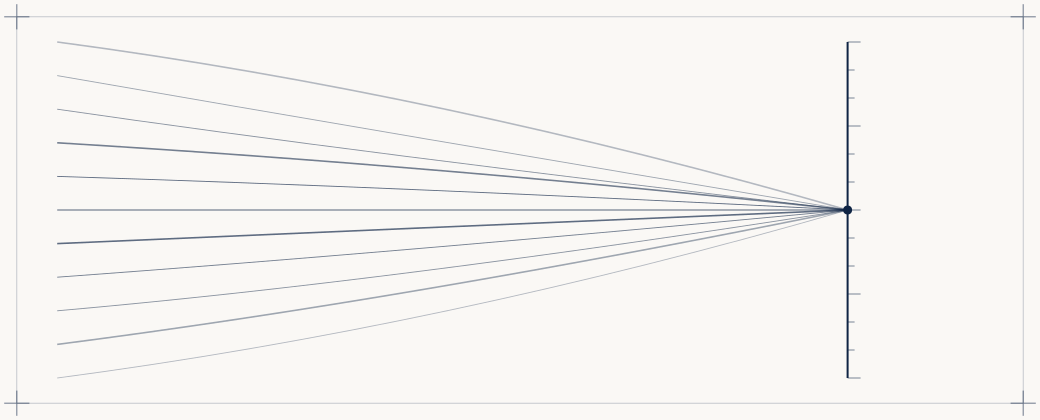
Activity accumulates. Only a system compounds.
The alternative is not less marketing. It is marketing where each stage is obligated to hand something usable to the next one. That obligation costs a quarter to install and pays back for as long as the organization keeps it.
The compounding runs both ways. A system compounds understanding. Activity compounds interpretation, and interpretation is where budgets quietly go.
Key Takeaways
- The breaking point is structural and arrives at a predictable size.
- Adding components to an unstructured function multiplies interpretation, not output.
- The cost of installing a system is one quarter; the cost of not installing it recurs.
- A system’s return shows up as absence, which is why it is under-funded.